Tag Archives: Cross-Cultural Legal Communication & Negotiation Module

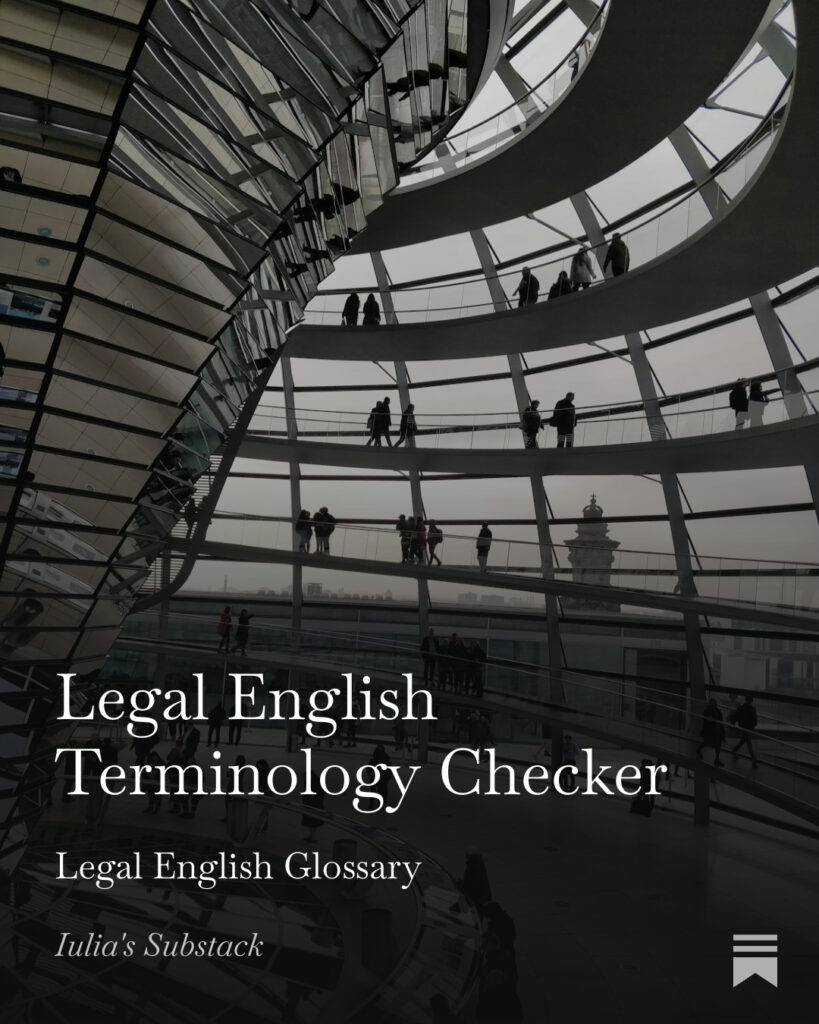
New Issue: Legal English Terminology Checker Newsletter May 2026

🔷 Struggling with legal English terminology?

Master the language that makes the difference with our brand-new Legal English Terminology Checker newsletter!

🔷 Whether you’re drafting contracts, negotiating deals, or communicating with clients, using precise legal terms is crucial. Our newsletter is your personal guide to navigating the complexities of legal jargon with confidence and clarity.

💡 Ready to elevate your legal English skills?

➡️ Check out our new issue of Legal English Terminology Checker newsletter! 👇

https://legalenglishterminologychecker.substack.com/p/legal-english-terminology-checker-369

💡 Read more about Start English professional English courses and the list of 9 innovative activities that take place during our bespoke legal English training. 👇
https://blog.seocopywriting.ro/2025/11/23/why-it-is-important-for-lawyers-to-learn-legal-english-challenges-and-tips/.

💥 Would you be interested in learning how we could help you excel in your global legal practice?

🔔Contact
➡️ 0722 841 053 (WHATSAPP)
➡️ http://www.seocopywriting.ro/en/contact-us.php

💡 Read more about our professional Legal English courses for Berlin practitioners: English for Legal Professionals in Berlin!

💡 Enrol in our START ENGLISH CLUB themed courses! Speak the future into existence!
https://docs.google.com/forms/d/e/1FAIpQLSdXS6XjktuPqBevONgx85sI3hiuCLC5zmpPryctH69Tn4ehkw/viewform

ENGLISH FOR LAWYERS: What is the hardest legal term you’ve had to explain in English?

ENGLISH FOR LAWYERS: What is the hardest legal term you’ve had to explain in English?

What is the hardest legal term you’ve had to explain in English?
For many multilingual lawyers, the hardest legal terms are not the ones with the fanciest Latin, but the ones that are deceptively simple in English and completely untranslatable in one word in the client’s language. The “hardest” term, in practice, is often the one that sits at the intersection of language, legal culture, and client expectations.

Our students have likely realized by now that legal Latin is not as difficult as it seems. We have covered the topic of “consideration” in the following article: : https://blog.seocopywriting.ro/2026/05/21/english-for-lawyers-what-is-the-hardest-legal-term-youve-had-to-explain-in-english/.

“Indemnify, defend and hold harmless” – three verbs, one anxiety spike
For international clients, this triad often looks like stylistic overkill. For common law drafters, those three verbs cover different kinds of risk allocation and procedure.

Why it’s hard:

The clause is almost always embedded in dense boilerplate
Many languages can’t mirror the nuance between “indemnify”, “defend”, and “hold harmless”
Clients often underestimate the financial impact: “It’s just standard, right?”
A structured explanation that works well in English and can be paraphrased into other languages:

Break it into roles

“Defend”: who pays and manages the lawyers if someone sues.
“Indemnify”: who reimburses money paid because of a claim (judgment, settlement, costs).
“Hold harmless”: who carries the final financial burden so the other party stays ‘untouched’ by the loss.

Anchor it to real scenarios
“If a third party sues our counterparty because of something we did, we might be required to step in, hire and pay the lawyers, and reimburse any damages — even if we are not formally named in the lawsuit.”

Make the risk visible
“This is not just about abstract responsibility; this is potentially about paying for someone else’s lawsuit in a foreign court, possibly under a law we didn’t choose.”
With international clients, it often helps to explicitly compare:

“In your domestic contracts, do you see clauses that require one party to pay all losses the other suffers because of third-party claims? This is the English version of that idea, but often broader.”

……………………………..
✨Hi, I am Iulia,
Legal English Trainer | SEO Copywriter | Helping Lawyers Master English for Global Wins | Founder @ Start English | Empowering Global Legal Pros with Badass English & SEO Mastery
💥We can work together to craft your personalized content, polish your English-speaking skills, and secure your place in the sun.
⚡️Without excellent English, there’s no path forward!

🔔Contact
➡️ 0040722 841 053 (WHATSAPP)
➡️ http://www.seocopywriting.ro/en/contact-us.php

LEGAL ENGLISH FOR GLOBAL PRACTITIONERS
START ENGLISH: ENGLEZA PENTRU AVOCAȚI

https://blog.seocopywriting.ro/2026/05/05/english-for-lawyers-what-do-you-learn-in-legal-writing-classes/

ENGLISH FOR LAWYERS: What is the hardest legal term you’ve had to explain in English?

ENGLISH FOR LAWYERS: What is the hardest legal term you’ve had to explain in English?

For many lawyers and legal English trainers, the “hardest term” is not necessarily the most obscure Latin phrase, but the one that looks deceptively simple and yet refuses to make sense to non‑lawyers. One strong contender is the idea of “consideration” in contract law.

In everyday English, “consideration” means politeness or thoughtfulness: “Thank you for your consideration.” In contract law, it means something completely different: the bargained-for exchange that makes a promise legally binding.

When explaining this to learners, the difficulty usually comes from three angles:

It is an ordinary word with a technical meaning, so learners think they understand it but actually don’t.

There is no perfect one-word equivalent in many languages, so direct translation fails.

The concept is abstract: it is not just “payment” or “money”, but anything of value exchanged (a service, a promise, a right, an act, or even not doing something you have the right to do).

To make the term stick, it helps to move away from definitions and into simple stories.

Example 1:

A promises to give B a car as a gift next month.

B does nothing in return.

In common law, this is usually not an enforceable contract, because B has given no consideration. It is just a promise to make a gift.

Example 2:

A promises to give B a car next month.

B promises to pay 5,000 euros.

Now there is consideration on both sides: A’s car for B’s money. This is an enforceable contract (assuming other elements are met).

Example 3:

A says: “If you stop smoking for one year, I will pay you 1,000 euros.”

B actually stops smoking for a year.

Here, B’s self‑restraint (giving up a legal freedom) can be consideration. It shows that consideration is not only money or physical things, but any legal “value” exchanged.

These kinds of examples help learners see that consideration is about exchange: each party gives or promises something the law recognizes as value.

What makes “consideration” especially challenging for non‑native speakers is that it forces them to adjust their mental model of what a “contract” is. Many learners come from legal systems where:

The focus is on form (for example, the contract must be in writing or notarized).

Or the focus is mainly on serious intention and cause/reason, not on this specific idea of exchange.

So when they meet “consideration,” they are not only learning a new word, but also adapting to a different philosophy of obligations: a contract is based on a bargain, not just on a serious promise.

As a result, explaining “consideration” often turns into a broader discussion about:

Why a purely free promise is generally not enforceable.

Why courts care that both sides give something up.

How this differs from civil law concepts like “cause” or “legal basis”.

We will cover all of these topics in upcoming articles. Stay tuned!

……………………………..
✨Hi, I am Iulia,
Legal English Trainer | SEO Copywriter | Helping Lawyers Master English for Global Wins | Founder @ Start English | Empowering Global Legal Pros with Badass English & SEO Mastery
💥We can work together to craft your personalized content, polish your English-speaking skills, and secure your place in the sun.
⚡️Without excellent English, there’s no path forward!

🔔Contact
➡️ 0040722 841 053 (WHATSAPP)
➡️ http://www.seocopywriting.ro/en/contact-us.php

LEGAL ENGLISH FOR GLOBAL PRACTITIONERS
START ENGLISH: ENGLEZA PENTRU AVOCAȚI

https://blog.seocopywriting.ro/2026/05/05/english-for-lawyers-what-do-you-learn-in-legal-writing-classes/

START LEGAL ENGLISH

💡 Elevate your legal career with our specialized group courses. High-level English for Law professionals at our most accessible price point.

💡 What is the hardest legal term you’ve had to explain in English?

💡 Read more about Start English professional English courses and the list of 9 innovative activities that take place during our bespoke legal English training. 👇

➡️ https://blog.seocopywriting.ro/2025/08/28/what-does-our-bespoke-legal-english-course-entail/

➡️ https://blog.seocopywriting.ro/2025/11/20/curs-de-engleza-juridica-pentru-avocati/

➡️ https://blog.seocopywriting.ro/2025/11/23/why-it-is-important-for-lawyers-to-learn-legal-english-challenges-and-tips/

💡 We are Start English and we specialize in bespoke legal English courses designed exclusively for international legal practitioners like yourself. Our training combines practical, innovative activities such as our Legal Document Editor and the “Legal English Case Challenge” to enhance both your drafting and analytical skills. We also offer immersive experiences like cross-cultural communication modules, client-facing masterclasses, and arbitration simulations.

💥 Would you be interested in learning how we could help you excel in your global legal practice?

🔔Contact
➡️ 0040722 841 053 (WHATSAPP)
➡️ http://www.seocopywriting.ro/en/contact-us.php

LEGAL ENGLISH FOR LAWYERS

✳️ Discount START ENGLISH CLUB: 10%
✳️ Check out the link below:
https://docs.google.com/forms/d/e/1FAIpQLSeWZ0YFW_0m1hQDVygg1OzPJqt8DjClTTSqS8wn0M9IIQjyIA/viewform

ENGLISH FOR LAWYERS: What Do You Learn in Legal Writing Classes?

START ENGLISH: What Do You Learn in Legal Writing Classes?

🔷 When people hear “legal writing class,” they often think of grammar, formal language, and long documents. But for international lawyers, legal writing classes teach something much more valuable: how to think clearly and communicate with precision.

💡 That may sound simple, but in legal practice, it makes a huge difference.

🔷 Legal writing is not just about sounding professional. It is about helping another person understand a legal issue quickly, accurately, and confidently. Whether you are writing to a client, a colleague, or a court, your words need to do real work. They need to explain, persuade, and guide.

🔷 One of the first things lawyers learn is that clarity matters more than complexity. A long sentence is not automatically a better sentence. In fact, the best legal writing often comes from removing unnecessary words, simplifying structure, and making the main point easier to see.

💡 Another important lesson is structure. Good legal writing does not feel random or overloaded. It has a clear beginning, a logical middle, and a conclusion that makes sense. The reader should never have to guess what the writer is trying to say.

🔷 Legal writing classes also teach something that many lawyers only learn after years of practice: audience matters. The way you write for a client is not the same as the way you write for a partner, a judge, or an opposing counsel. Strong legal writers know how to adapt their tone, level of detail, and vocabulary depending on who is reading.

🔷 And then there is revision. Legal writing is rarely perfect in the first draft. Students learn how to edit carefully, check for ambiguity, and improve both style and logic. That process builds discipline, and over time, it makes writing much stronger.

🔷 For international lawyers, these skills are especially important. Legal writing is often the bridge between legal knowledge and professional credibility. It helps lawyers work across borders, avoid misunderstandings, and communicate complex ideas in a way that others can actually use.

💡 In the end, legal writing classes do more than improve writing. They help lawyers become clearer thinkers, stronger communicators, and more effective professionals.

💥 Would you be interested in learning how we could help you excel in your global legal practice?

🔔Contact
➡️ 0722 841 053 (WHATSAPP)
➡️ http://www.seocopywriting.ro/en/contact-us.php

💡 Enrol in our START ENGLISH CLUB themed courses! Speak the future into existence!
https://docs.google.com/forms/d/e/1FAIpQLSdXS6XjktuPqBevONgx85sI3hiuCLC5zmpPryctH69Tn4ehkw/viewform

New Issue: Legal English Terminology Checker Newsletter April 2026

🔷 Struggling with legal English terminology?

Master the language that makes the difference with our brand-new Legal English Terminology Checker newsletter!

🔷 Whether you’re drafting contracts, negotiating deals, or communicating with clients, using precise legal terms is crucial. Our newsletter is your personal guide to navigating the complexities of legal jargon with confidence and clarity.

💡 Ready to elevate your legal English skills?

➡️ Check out our new issue of Legal English Terminology Checker newsletter! 👇

https://legalenglishterminologychecker.substack.com/p/legal-english-terminology-checker-473

💡 Read more about Start English professional English courses and the list of 9 innovative activities that take place during our bespoke legal English training. 👇
https://blog.seocopywriting.ro/2025/11/23/why-it-is-important-for-lawyers-to-learn-legal-english-challenges-and-tips/.

💥 Would you be interested in learning how we could help you excel in your global legal practice?

🔔Contact
➡️ 0722 841 053 (WHATSAPP)
➡️ http://www.seocopywriting.ro/en/contact-us.php

💡 Read more about our professional Legal English courses for Berlin practitioners: English for Legal Professionals in Berlin!

💡 Enrol in our START ENGLISH CLUB themed courses! Speak the future into existence!
https://docs.google.com/forms/d/e/1FAIpQLSdXS6XjktuPqBevONgx85sI3hiuCLC5zmpPryctH69Tn4ehkw/viewform

SEO for Global Legal Practitioners

🔷 For lawyers, consultants, and other professional service providers operating in multiple jurisdictions, “think global, act local” is no longer just a slogan—it’s your SEO survival strategy. Global SEO enables practitioners to appear in the right language, country, and context when prospective clients search for complex, cross‑border services.
Below is a practical framework you can apply whether you’re marketing legal English courses, corporate law, or international dispute‑resolution services.

🔷 What global SEO means for professionals
Global (or international) SEO refers to optimizing a website so it ranks effectively across several countries and languages, matching local search intent rather than just translating content word‑for‑word. For practitioners, this means aligning your site with how clients in each market search: for example, “cross‑border mergers and acquisitions lawyer in Frankfurt” versus “M&A counsel for EU‑US transactions” in English‑speaking markets.

Implications:

➡️ Rankings must reflect local regulations, conventions, and professional titles (e.g., “solicitor” vs “avocat” vs “Anwalt”).
➡️ Top‑ranking pages are not always generic “about us” segments, but jurisdiction‑specific service pages, FAQs, and how‑to guides that answer local search queries.

🔷 Step 1: Define your target markets
Before you build anything, decide which jurisdictions you want to prioritize and why.

🔔Ask:
Where do most of your inquiries already come from (Google Search Console, LinkedIn, referrals)?
Which languages and legal systems are most relevant to your practice (e.g., English, German, French; EU‑centric, common‑law‑heavy, etc.)?

🔔A focused approach—say, 3–5 core markets—lets you:
Allocate content and backlinks more efficiently.
Avoid spreading content too thin and diluting signals in search engines.

🔷 Step 2: Localized keyword research
Keyword research for global practitioners must be culture‑aware, not just translation‑driven. For instance, a Romanian lawyer targeting UK clients should not simply translate “contract review” but discover how UK‑based general counsels actually phrase that need (e.g., “commercial contract review UK,” “outsourced legal review for SMEs”).

🔔Best‑practices tips:
Use tools such as Semrush, Market Explorer, or Serp‑data platforms to uncover local keywords and search volume by country.
Involve native‑speaking colleagues or professional translators to validate search intent and phrasing, especially for nuanced professional services.

🔷 Step 3: Technical setup for multiple markets
Google needs to understand which version of your site is meant for which audience.

🔔For global practitioners, this usually means:
Country‑specific URLs (subdomains like uk.example.com or subdirectories like /en‑gb/), or even separate domains if you operate as distinct local entities.
Correct hreflang tags so that English‑speaking clients in Germany see the /en‑de/ page, while French speakers in France see the /fr/ version.

🔔Technical wins:
Clear, consistent site structure (e.g., /services/mergers‑acquisitions/ vs /servicii/fuziuni‑si‑achizitii/) mapped to each language/market.
Fast, mobile‑friendly layouts that respect local UX expectations (e.g., form length, language toggle position).

🔷 Step 4: Localized, practitioner‑oriented content
Once structure and keywords are in place, content must signal expertise and jurisdictional awareness.

🔔For a legal English educator or international lawyer, this looks like:
Service pages tailored to specific markets (e.g., “Legal English for French‑speaking in‑house lawyers,” “EU‑US M&A contract drafting workshops”).
Blog posts and FAQs that mirror real client questions: “How do I structure a contract for clients in Germany?” or “Common mistakes when drafting English‑law contracts for Romanian companies.”

🔔Key principles:
Use case‑driven examples, not generic theory.
Embed local terminology, statutory references, and common pitfalls (without giving legal advice) to boost relevance and trust.

🔷 Step 5: Local link‑building and visibility
Off‑site SEO for global practitioners is less about “more links” and more about relevant signals in each market.

🔔Useful tactics include:
Guest articles or interviews on legal‑education platforms, industry associations, or chambers of commerce in your target countries.
Speaking appearances, webinars, and LinkedIn‑hosted events that generate inbound mentions and citations.

🔔Wherever possible:
Prioritize local‑domain links (e.g., .de, .fr, .ro) with anchor text that reflects your service niche.
Maintain consistent NAP (Name, Address, Phone) and professional profiles across directories relevant to your practice area.

🔷 Step 6: Monitoring and iterating
Global SEO is not “set and forget.”

🔔Practitioners should:
Regularly review traffic by country and language in Google Search Console or similar tools.
Track which service pages and blog posts convert best (form fills, brochure downloads, webinar signups) and double‑down on those formats and topics.

🔔Fine‑tuned iteration:
Update content when regulations or practice trends shift (e.g., new EU directives, changes in cross‑border tax rules).
Experiment with local search features (FAQ schema, local structured data) to capture more SERP real estate in each market.

🔷 For global practitioners, SEO is less about technical tricks and more about demonstrating genuine, cross‑border authority. By aligning keyword intent, technical structure, and content with the habits and languages of each target market, you turn your website into a 24/7, multilingual practice‑development tool that attracts the right kind of international clients.

🔔Contact
➡️ 0040722 841 053 (WHATSAPP)
➡️ http://www.seocopywriting.ro/en/contact-us.php

💡 Enrol in our START ENGLISH CLUB themed courses! Your comprehensive solution for English language learning!

Photo by Vitaly Gariev on Unsplash

New Issue: Legal English Terminology Checker Newsletter March 2026

🔷 Struggling with legal English terminology?

Master the language that makes the difference with our brand-new Legal English Terminology Checker newsletter!

🔷 Whether you’re drafting contracts, negotiating deals, or communicating with clients, using precise legal terms is crucial. Our newsletter is your personal guide to navigating the complexities of legal jargon with confidence and clarity.

💡 Ready to elevate your legal English skills?

➡️ Check out our new issue of Legal English Terminology Checker newsletter! 👇

https://legalenglishterminologychecker.substack.com/p/legal-english-terminology-checker-e05

💡 Read more about Start English professional English courses and the list of 9 innovative activities that take place during our bespoke legal English training. 👇
https://blog.seocopywriting.ro/2025/11/23/why-it-is-important-for-lawyers-to-learn-legal-english-challenges-and-tips/.

💥 Would you be interested in learning how we could help you excel in your global legal practice?

🔔Contact
➡️ 0722 841 053 (WHATSAPP)
➡️ http://www.seocopywriting.ro/en/contact-us.php

💡 Read more about our professional Legal English courses for Barcelona practitioners: English for Legal Professionals in Barcelona!

💡 Enrol in our START ENGLISH CLUB themed courses! Your comprehensive solution for English language learning!

Photo by LYCS Architecture on Unsplash.

Neue Ausgabe: Newsletter zur Rechtsenglisch-Terminologie – Februar 2026

🔷 For our German readers, we have translated our article: https://blog.seocopywriting.ro/2026/02/28/new-issue-legal-english-terminology-checker-newsletter-february-2026/

🔷 Haben Sie Schwierigkeiten mit der englischen Rechtsterminologie?

💡 Meistern Sie die Sprache, die den entscheidenden Unterschied macht – mit unserem brandneuen Newsletter „Legal English Terminology Checker“!

🔷 Ganz gleich, ob Sie Verträge entwerfen, Verhandlungen führen oder mit Mandanten kommunizieren: Die Verwendung präziser Rechtsbegriffe ist unerlässlich. Unser Newsletter ist Ihr persönlicher Leitfaden, um sich sicher und klar in der Komplexität der juristischen Fachsprache zurechtzufinden.

💡 Bereit, Ihre Fachkenntnisse im Rechtsenglisch auf das nächste Level zu heben?

🔷 Schauen Sie in die neue Ausgabe unseres „Legal English Terminology Checker“-Newsletters rein!

https://legalenglishterminologychecker.substack.com/p/legal-english-terminology-checker-fce

🔷 Erfahren Sie mehr über die Professional-English-Kurse von Start English und die Liste der 9 innovativen Aktivitäten, die Teil unseres maßgeschneiderten Rechtsenglisch-Trainings sind.

https://blog.seocopywriting.ro/2025/12/01/warum-es-wichtig-ist-dass-anwalte-juristisches-englisch-lernen-herausforderungen-und-tipps/

🔷 Hätten Sie Interesse daran zu erfahren, wie wir Sie dabei unterstützen können, in Ihrer globalen Rechtspraxis exzellente Ergebnisse zu erzielen?

🔔Contact
➡️ 0722 841 053 (WHATSAPP)
➡️ http://www.seocopywriting.ro/en/contact-us.php

LEGAL ENGLISH FOR BERLIN LAWYERS

Nueva edición: Boletín de verificación de terminología de inglés jurídico, febrero de 2026

For our Spanish readers we have translated the article: https://blog.seocopywriting.ro/2026/02/28/new-issue-legal-english-terminology-checker-newsletter-february-2026/.

🔷 ¿Tienes dificultades con la terminología legal en inglés?

¡Domina el idioma que marca la diferencia con nuestro boletín informativo completamente nuevo sobre el verificador de terminología legal en inglés!

🔷 Ya sea que estés redactando contratos, negociando acuerdos o comunicándote con clientes, el uso de términos legales precisos es crucial. Nuestro boletín es tu guía personal para navegar por las complejidades de la jerga legal con confianza y claridad.

💡 ¿Listo para mejorar tus habilidades de inglés legal?

➡️ ¡Echa un vistazo a nuestro nuevo número del boletín Legal English Terminology Checker! 👇

https://legalenglishterminologychecker.substack.com/p/legal-english-terminology-checker-fce

💡 Lee más sobre los cursos de inglés profesional de Start English y la lista de 9 actividades innovadoras que se llevan a cabo durante nuestra formación personalizada de inglés jurídico. 👇

https://blog.seocopywriting.ro/2025/11/23/why-it-is-important-for-lawyers-to-learn-legal-english-challenges-and-tips/.

💥 ¿Estaría interesado en saber cómo podríamos ayudarle a destacar en su práctica legal global?

🔔Contact
➡️ 0722 841 053 (WHATSAPP)
➡️ http://www.seocopywriting.ro/en/contact-us.php

Photo by Beatriz Cattel on Unsplash