Tag Archives: Thomas Hardy

The Hand of Ethelberta

“I have seldom known a man cunning with his brush who was not simple with his tongue; or, indeed, any skill in particular that was not allied to general stupidity.”
– from The Hand of Ethelberta (1876) by Thomas Hardy

Thomas Hardy is one of my favorite Victorian writers, mostly due to the magic depiction of the fictitious Wessex county and Egdon Heath in The Return Of The Native.

Thomas Hardy’s Wessex is the fictional literary landscape as the setting for his major novels, located in the south and southwest of England. Hardy named the area “Wessex” after the medieval Anglo-Saxon kingdom that existed in this part of that country prior to the unification of England by Æthelstan. Although the places that appear in his novels actually exist, in many cases he gave the place a fictional name.

Art – Josef Stoitzner – After the Rain, 1925.

Idealization In Love

The great aids to idealization in love were present here: occasional observation of her from a distance, and the absence of social intercourse with her — visual familiarity, oral strangeness. The smaller human elements were kept out of sight; the pettinesses that enter so largely into all earthly living and doing were disguised by the accident of lover and loved-one not being on visiting terms; and there was hardly awakened a thought in Boldwood that sorry household realities appertained to her, or that she, like all others, had moments of commonplace, when to be least plainly seen was to be most prettily remembered. Thus a mild sort of apotheosis took place in his fancy, whilst she still lived and breathed within his own horizon, a troubled creature like himself.
Thomas Hardy, Far from the Madding Crowd

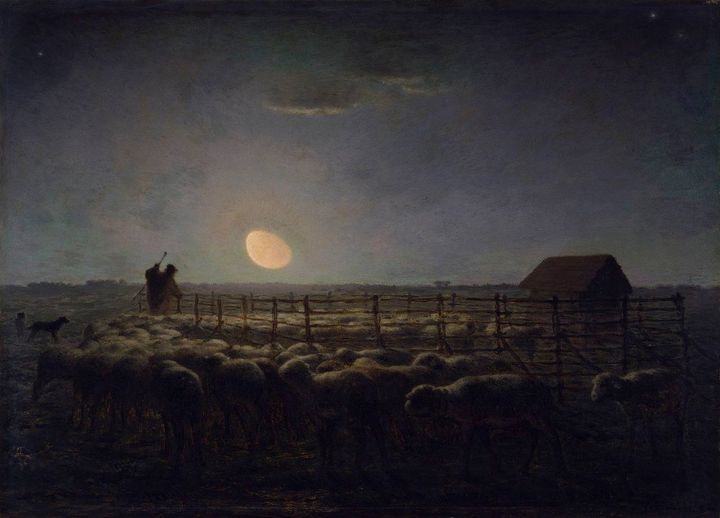
Jean-François Millet –The Sheepfold, Moonlight, 1856-60.

(One of my favourite quotes)

About Reading

She Knew

“She knew how to hit to a hair’s breadth that moment of evening when the light and the darkness are so evenly balanced that the constraint of day and the suspense of night neutralize each other, leaving absolute mental liberty…At times her whimsical fancy would intensify natural processes around her till they seemed a part of her own story. Rather they became a part of it; for the world is only a psychological phenomenon, and what they seemed, they were. The midnight airs and gusts, moaning amongst the tightly wrapped buds and bark of the winter twigs, were formulae of bitter reproach. A wet day was the expression of irremediable grief at her weakness in the mind of some vague ethical being whom she could not class definitely as the God of her childhood, and could not comprehend as any other.”
Thomas Hardy, Tess of the D’Urbervilles

Art – Edwin Romanzo Elmer – An Imaginary Scene, 1892.